
How to Pack a Surfboard for Air Travel
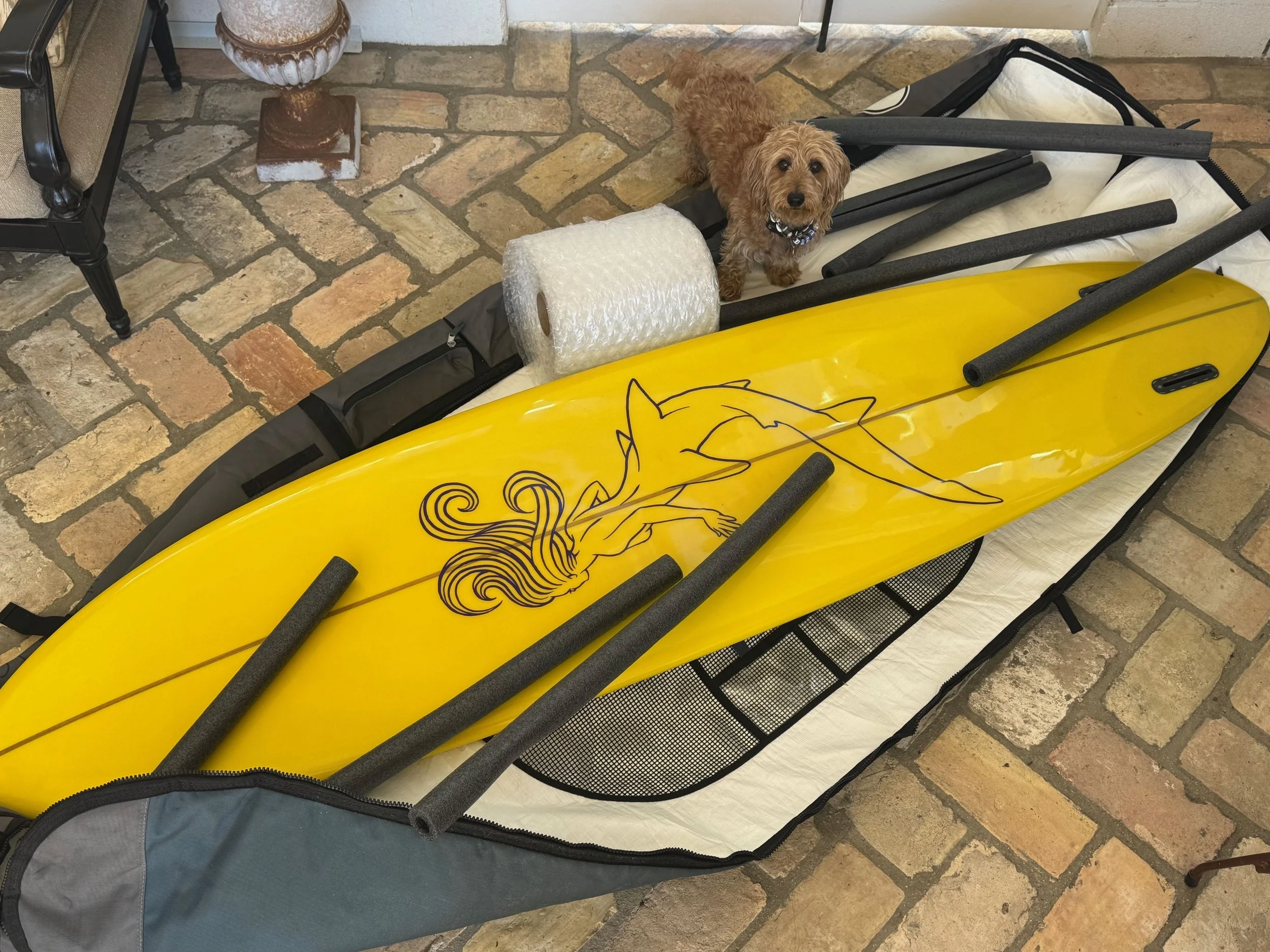
The surf trip is planned and booked. Now comes the part most surfers dread: packing the board bag.
Everyone seems to have their own technique for packing surfboards for air travel. This is mine. It’s a bit of a pain, but so far, so good. Please share your tips and tricks in the comments!
The best way I've found to pack a surfboard for air travel is pretty simple: protect the rails, nose, tail, deck and bottom individually, while keeping the board bag as light as possible.
Before You Start Packing
If you’re headed somewhere with colder water, check the water temperature at your destination before deciding which wetsuits to bring. Surfline and WaveCast are great resources for checking water temperatures and forecasts before you leave.
I usually pack two wetsuits, one for dawn patrol and another for the warmer part of the day. Sometimes I bring two of the same thickness. On a surf trip, it’s really nice to be able to trade them out and have one completely dry for the next session.
Just remember that everything you put in your board bag adds weight.
Fins: In the Bag or Out?
I prefer not to travel with my fins in the board bag. I put them in my backpack instead. They're hard, they add weight to the board bag and they're one less thing that can press against the board.
I've learned the hard way to bring extra fin box screws and a couple of fin keys. There are few things more annoying than arriving at your surf destination, putting your board together and discovering that you've lost a fin screw or misplaced your fin key.
Keep the fins, fin screws and keys together somewhere you'll be able to find them easily when you arrive.
Protect the Rails, Nose and Tail
The vulnerable parts of the board need some extra attention.
Foam pipe insulation - the inexpensive foam tubes plumbers use around pipes - works really well. Cut it to fit around the rails and use additional pieces to protect the nose and tail. I tape it in place with packing tape and bring the roll with me for the trip back.
It's inexpensive, lightweight, easy to work with and provides another layer between your board and whatever happens to your bag between check-in and baggage claim.
If you're traveling on one of those tiny planes, they may take your boards out of the bag. The foam tubes around your nose and rails really come in handy in those situations.
Protect the Top and Bottom
I also want protection across the deck and bottom of the board.
Bubble wrap is lightweight and gives the board another layer of cushioning without adding much weight to the bag. If you're traveling with two boards, make sure there is protection between them as well.
And watch anything hard that you pack alongside your board.
Wetsuits can provide some additional cushioning, but keep wetsuit zippers away from the board. You don't want a hard zipper pressed against the fiberglass for an entire flight.
The same goes for my leash. If it has any hard parts that could press against the board, I put it in my backpack instead.
A little extra bubble wrap between the rails and the sides of the bag isn't a bad idea either. It doesn't weigh much, and I love the extra protection.
Keep the Board Bag Light
This is especially important when you're traveling with two boards.
The heavier the bag, the harder it is for baggage handlers to move, and I figure the harder it is to move, the greater the chance it's going to get dragged, dropped or handled roughly.
There's another good reason to watch the weight: overweight baggage fees.
Know your airline's current surfboard and baggage rules before you leave. Airline policies and weight limits vary, so check them directly before every trip rather than assuming the rules are the same as your last flight.
Wheels or No Wheels?
This is always a trade-off.
Wheels add weight, but when you're navigating an airport with a larger board bag plus your regular luggage, they can make life considerably easier. Carrying a board bag by the shoulder strap gets old quickly, so I love having wheels.
My only question is: Why has no one put swivel wheels on a board bag?
Anyone who has tried maneuvering a midsize or longboard bag through an airport knows exactly what I'm talking about.
For me, the most important characteristics of a travel board bag are:
Light enough that I'm not wasting my weight allowance on the bag itself
Protective enough that I trust putting my boards in it
Good-quality zippers that continue to open and close smoothly as the bag ages
Wheels that can survive airports, parking lots and everything in between
Pro-Lite is my go-to surfboard bag with wheels, right now. It’s held up through multiple trips and is still going strong.
The Two Sighs of Relief
There are two moments when I finally relax after flying with a surfboard.
The first is when I'm standing at oversized baggage and see my board bag coming out. It made it.
The second comes when I get to where I'm staying, unzip the bag and unwrap everything.
Same board I packed.
No pressure dings. No cracks. No mysterious new dings of any kind.
That's when the surf trip really begins.
Everyone has their own technique for packing a surfboard. This is mine. It takes a little extra time, but so far, so good.